
By Derek Bye | B.S. Exercise Science, ACSM-CPT
Among many different trends in the fitness industry is a term called “intermittent fasting”. Intermittent fasting basically means you go through relatively extended periods of time of not eating (fasting) and then consume all your meals in a shorter eating window.
Let’s not make intermittent fasting more complicated than it needs to be. You actually go through periods of fasting EVERY DAY. Yes, you are technically fasting at any time when you’re not consuming food. If you sleep for eight hours a night (which I hope you do), then you are in a “fasted state” for those eight hours. If you haven’t eaten anything in the past two hours, then you have technically been fasting for two hours. Let’s stop thinking of “intermittent fasting” objectively where we follow a strict guideline as to when we can or cannot eat, and instead take a more subjective holistic approach to get real results.
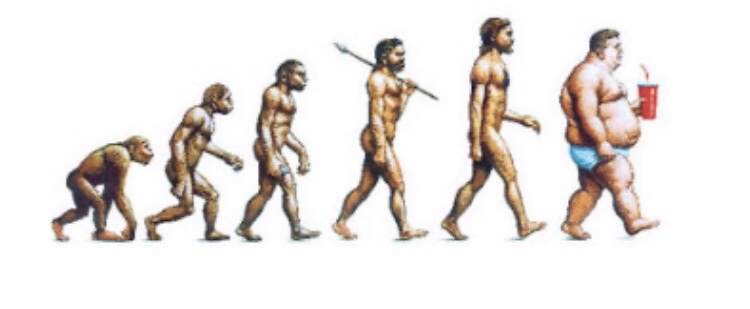
So why should everybody fast? Well, the answer is actually quite simple. Humans are not designed to be eating food all f!*king day! It astonishes me how simple of a concept this is and how complex we make it. I will go into the science in a little bit but for now consider this. Humans have evolved from hunting/gathering food to sitting on couches and grabbing food from the refrigerator whenever we damn please. At one point in time, food wasn’t readily available 24/7 like it is today. The high availability of food is what’s causing a massive surge of disease within our culture. Have you ever noticed that the United States is the number one leader in preventable diseases such as heart disease, diabetes, and obesity? The United States is also one of few places in the world where the food is so easy to come by. I can guarantee that you’ll probably never find a type 2 diabetic in a less developed country. Americans are simply eating too much food and eating it too often.
What are the benefits of fasting?
• Fat loss + muscle maintenance (when done properly)
• Increased growth hormone (will help increase metabolism)
• Balances hormones
• Enhanced brain function (less brain fog, better memory)
Fasting, Backed by Science:
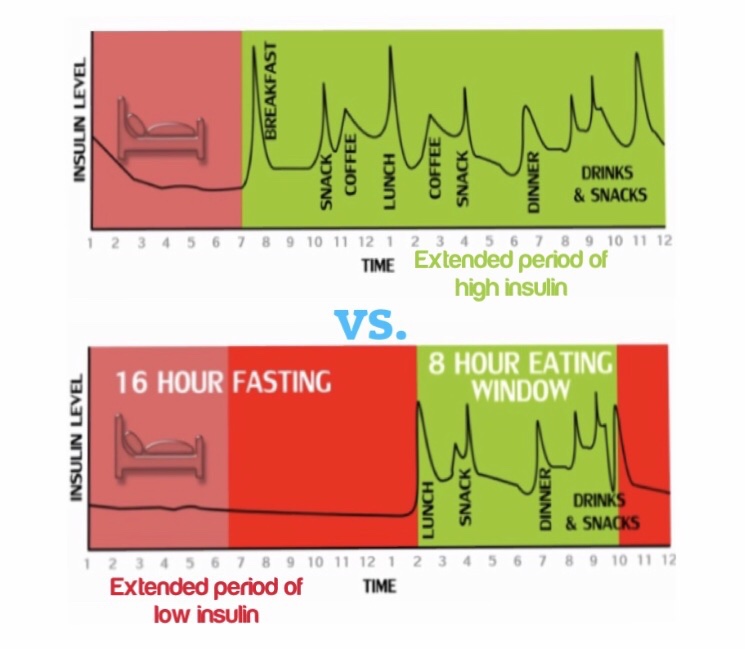
This chart above represents your insulin levels during a typical day of eating versus a day of fasting. The green window represents times of eating where insulin is relatively high, and the red window represents times of fasting where insulin is low. As you can see in the chart, a typical day of eating results in multiple insulin spikes throughout the entire day. This is the primary cause of what is known as “insulin resistance”. Insulin resistance occurs when the cells in your body are so used to insulin being present all the time that they begin to become resistant to it. This results in even more insulin being produced, which enhances the cycle causing the cells to be even more resistant.
The red window represents fasting time, where insulin levels are really low. During this time, the opposite hormone of insulin, called glucagon, is used to pull sugar back out of storage so they can be used for energy. This system is underdeveloped in most people since their body is so used to always having insulin present. Through intermittent fasting, we can train our body release less insulin and lower our insulin resistance.
Why is insulin resistance bad?
Insulin resistance is the cause of many diseases within the body, such as type 2 diabetes, memory loss (brain fog), and fatty liver disease. It essentially prevents your body from being able to actually utilize sugar, and instead it’s stuck floating around in the blood stream rather than actually being used. Insulin resistance at the brain prevents sugar from entering the brain cells and feeding them energy. This results in brain cell degeneration and memory loss over time.
Fasting for Fat Loss and Muscle Maintenance:
Fasting is also highly effective for improving our overall body composition. One of the most beneficial effects from fasting is the surge in natural growth hormone as a result of not eating for a prolonged period of time. When your body is in a fasted state, growth hormone is increased as a result as the body’s natural mechanism to prevent the breakdown of muscle tissue. This response is programmed into our bodies through evolution where we had to hunt and gather for food at one time. When no food is available for a while, your body does it’s best to try to preserve muscle tissue and instead will burn primarily the fat stores for energy. This was once beneficial for humans because it allowed us to maintain the strength needed to continue to hunt/gather food.
We can still take advantage of this evolutionary adaptation but there’s one rule we need to follow. We need to give our body a reason to keep the muscle mass. This means that we should be lifting heavy weights so our body knows that our muscles are being used and it shouldn’t break them down for energy. Intermittent fasting combined with strength training will lead to a massive spike in growth hormone that will help maintain muscle and overall longevity over time.
How to fast:
If you’re new to fasting the first step would be to stop eating snacks between meals throughout the day. Every time you consume something, insulin is triggered. By consuming food less often throughout the day you’ll spike insulin less often, which will help lower insulin resistance.
The next step would be a 12 hour fast. That means that if you ate a 9PM the night before, you won’t eat again until 9AM the next morning. Gradually, you can increase the time from 12 hours to 14 hours, and evenentually an 18 or 20 hour fast. This doesn’t necessarily mean that you’ll be eating almost nothing every day. You’re simply condensing your meals into a smaller eating window rather than spreading them all throughout the day. Start trying this out and you’ll be amazed at how good you’ll actually feel once your body has become accustomed to it.
Hour
 D-BYE Lifts